Pages

Showing posts with label 1790s. Show all posts

Sunday, 23 April 2017

A riding habit petticoat (HSM #3)

Now that I am posting late HSM's, here is another one I finally got photos for just this week.


What the item is: 18th century riding habit petticoat

The Challenge, and how this item fulfills it: riding habits (as I'm going to call them, because I don't know a better name) were often worn in this period for outdoor leisure pursuits.

Fabric/Materials: 2 metres of unbleached cotton fabric fabric- that amazingly cheap IKEA drapery backing that they sell by the metre, 2 metres of twill tape

Pattern: my own

Year: 1785-1795

Notions: white cotton thread & wax

How historically accurate is it? The construction itself is decent, but I've had a difficult time figuring out whether or not the material I used is more like a (valuable) nankeen or a (cheap) onasbruck- I've never gotten a chance to see either of these types of fabric in real life, so that remains a mystery to me.

Hours to complete: not many

First worn: for pictures (with last year's HSM 11 waistcoat).

Total cost: $6 cad.

Friday, 16 December 2016

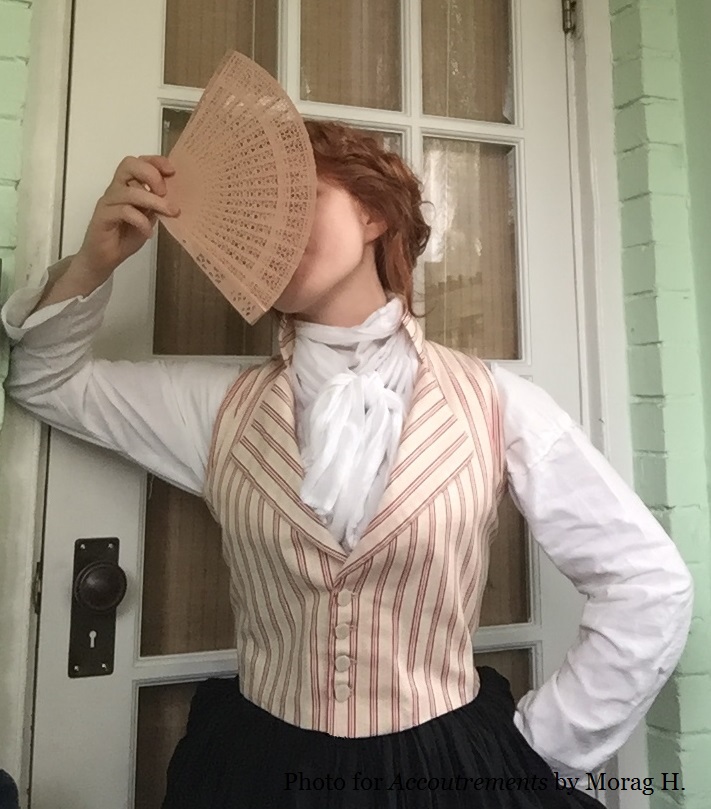
1790s habit waistcoat (HSM #11)

I was originally going to post this project for the Historical Sew Monthly "Pattern" challenge. It's been long enough though now that I figure I might as well post this under the Red challenge (it has some red in it). When I found the fabric I made this up with, it made me think of some of the roller-printed cottons from the turn of the 19th century. There is actually a small leaf scrolling pattern in between the stripes, which may or may not be very evident in the photos here.


Challenge: Red. I was originally going for the Pattern challenge, but that was a fairly long time ago now.

Material: 1/2 metre striped quilting cotton, about 1/2 metre beige drapery cotton, and some canvas for the fronts, lapels and collar.

Pattern: Adapted from plate XIX of The Cut of Men's Clothes, by Norah Waugh (and altered to fit over stays- I cut down the back, took in the waist, shortened the body a lot, and made the lapels slightly smaller). I used the descriptions of contemporary waistcoat construction in Costume Close Up (by Linda Baumgarten).

Period: 1790s.


Notions: Cotton thread, metal washers (bases for the buttons), wax, thin cotton tape.
I'm so happy with this stripe match!

How historically accurate is it?: Maybe 80%. I sewed it entirely by hand. It's completely made of cotton (although cotton thread still wasn't really a thing in this period, so points down for that). To be honest, I don't know that much about how accurate the weight of the striped fabric was for this (it's really thin).

I cut it down from a men's pattern, and the fit works for now, but next time I think I would cut a deeper curve on the front (Lesson learned: don't sew with striped fabric when trying a pattern for the first time!), I would also cut back the armscye some more (I had already cut it fairly substantially back from the original pattern.

*****

I took inspiration for the cut of my waistcoat from these gorgeous examples at the V&A museum:
I love the collar and lapels on the red waistcoat (besides its striking colour), and I thought the embroidery pattern on the striped one was very pretty.

  Left: Wool, 1790-95; Right: Linen with silver-gilt embroidery, 1790s

I didn't end up making it double breasted though, because I was so fed-up with buttonholes after sewing the first line of them!
I also changed the back from a lacing back, like these two examples have, to a back closed with ties (see above). Ties appear to also have been a period way of closing the back, though I don't know how common they were on women's waistcoats (as opposed to men's).

Hours to complete:
It took far longer than I had intended. I fully started this in the middle of the summer. It was all good though, because I learned lots of important things while making this piece.

First worn: For pictures.

Total cost: 0.5 metres striped fabric- $3
0.5 metres beige cotton- $1.50
0.25 yard canvas- $1.5
4 washers-15¢
some silk thread which I used on the buttonholes before realising that not all silk thread is appropriate as buttonhole twist- $4
= $10.15
All my other notions I already had.


A sample of materials and tools I used to make this. Ok, I didn't end up using the hammer- that was just there by coincidence- but all the rest I used! My table was unusually organised when I took this photo. Sadly enough, the table has since descended into pandemonium...


Thursday, 30 June 2016

Red chemise gown updates

I wrote earlier this year about my plans to make a red chemise gown- here is some of my progress on it!

The front is made up of two really long panels of fabric- I then put drawstrings on them at the neck and waist, and sewed them together from hem to waist. The cut of the back and shoulder straps (still yet to be covered) are from a basic late 18th century style bodice sloper that I drafted off my stays a while back. For the bodice construction on the back portions of the gown, I followed Serena Dyer's tutorial on 18th century gown construction, and stitched the fashion fabric onto my already-constructed bodice lining (not only is it historically accurate, but it's actually really nice and easy too).


Inside view of the front panel.
The lining of the gown (along with under-bodice front).

To give it some more structure (and a bit more modesty, given that the front only closes with two ties!) I added an under-bodice in the same material as the lining (a medium-ish weight linen-cotton blend).
I'll try to get some more photos up soon-ish of how it fits!

Friday, 29 January 2016

Red chemise gown: Inspirations

On a crisp day in early fall, I was wandering through my local Fabricland when I happened upon the most wonderful bolt of red cotton voile in the bargain discount room. While red was a very unsuitable colour for any kind of chemise/shift undergarment sort of thing, it was still the perfect weight for something else: that perfectly scandalous upscaled outer-garment cousin to the chemise, the Chemise Gown!

*****

More specifically, the idea of metres upon metres of red voile made me think of a pretty red 1791 gown featured in Hansen's Costume Cavalcade (which I swear was one of my favourite books when I was a kid). Some wonderful costumers on the 18th Century Sewing facebook page directed me to the original after which the illustration in the book was based. Here it is, the original fashion plate:

Journal de la Mode et du Go(u)t, 25 décembre, 1791-13ème cahier,
 in the collection of the Rijksmuseum.
 Displayed in glorious detail here, on their website.

The original source1 description of the gown:
"The coiffures en cheveux [hairstyles without a hat or pouf], having been for some time neglected, have returned more stylish than ever. Here is one in the new taste. It is formed all in large curls, and is trimmed with a garland of poppies. Gold earrings, totally round. Necklace made of a nakara [a shade of red] ribbon.

Kerchief of gauze or linen batiste, as you like, all plain.

Chemise gown, a la Coblentz, of nakara satin, trimmed along the bottom and on the amadis sleeves with black satin. We observe again, in passing, that the color of the gown is very striking in fabric, and one must not judge it by the illustration which necessarily renders it dead.

White gloves. Nakara shoes trimmed with black satin."
(Translation by Cassidy Percoco)

*****

My cotton voile will obviously have to stand in for satin, which I don't have. I'll be writing updates on the progress made on this dress in later posts!


1 18th Century Sewing group also alerted me to the fact that you can also access the full magazine it came from (with the original French text) digitally, through Gallica BNF- the full magazine makes an interesting read too- there are book/theatre reviews, small anecdotes and even sheet music in some of these editions!