Pages

Showing posts with label accessories. Show all posts

Thursday, 24 August 2017

Some yardsale fun...

One of the things I find really fun in the summer is yardsales. I ended up at a couple this summer and scored some amazing things!
Candlestick, wind-up travel clock, mini teapot and pepper grind, from the sale in my laneway.
I really loved the painting on this candlestick, and I've got a beeswax candle that will look very nice on it in the wintertime. The clock too will come in very useful, I think. I like that it's small and folds up, and I've been looking for a windup clock for my room for a while. Yes, they're noisy and have to be wound every day, but it somehow seems easier than having to go out and buy replacement batteries after a year! As for the mini teapot and pepper grind, I thought they were really pretty! The kid gloves (in the picture below) I also picked up here. They seem to just fit, and although the embroidered pair is a little stained, they're both so beautiful.
Coral necklace, some really groovy clip-on earrings, an antique crochet hook, hair curler and glove stretcher,  from the Kensington Market street sale, and two sets of kid gloves from the laneway.
I also ended up going to the very first Kensington Market Pedestrian Sunday of the season. For anyone who doesn't know, this is where they close off the streets of the Kensington Market neighbourhood one Sunday of each month through the summer and fall, and there are often different things going on in the street, like buskers playing. On this particular Sunday, because it was the first, the residents had a whole bunch of yardsales on the street. From this sale I got jewellry (coral necklace and gold clip-on's in the photo above) and some really neat vintage textile/clothing-related bits!

Friday, 30 June 2017

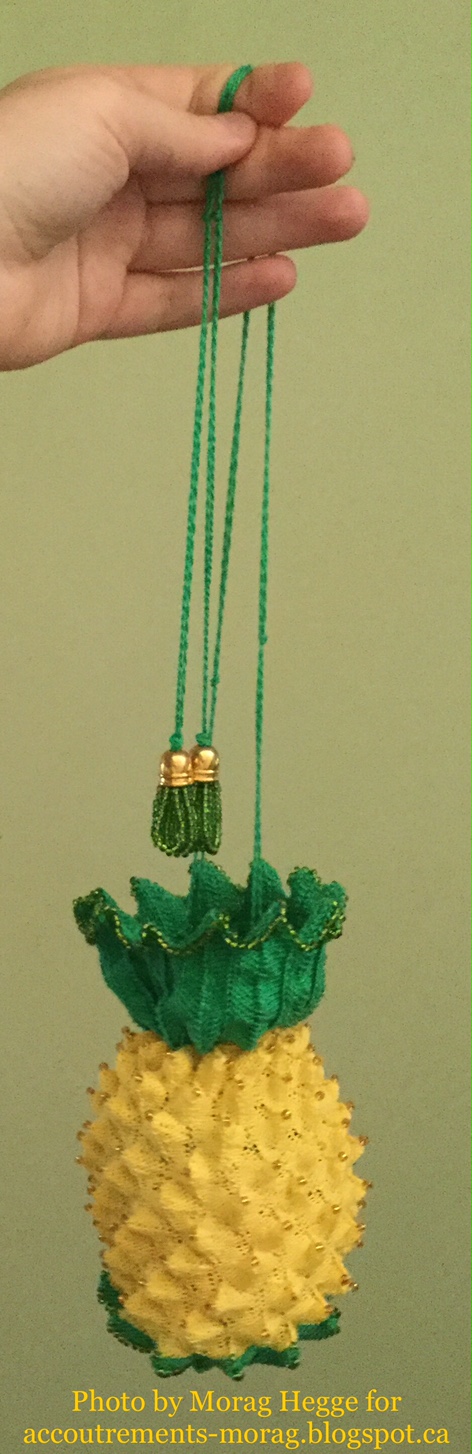
Pineapple reticule is done! Fun with beaded tassels and HSM #6

  
So I have finally completed for real my pineapple purse! It now closes and has straps! For information on the construction of the purse itself, see here


I based the look off of this example in the Kyoto Cosutme Institute's collection. The result is my own interpretation of it though. To make the straps, I wound two lengths of the green thread and doubled each one so that the two ends of thread spun in on each other- much like what is required to make a yoyo string... if you've ever had any experience with that. I then brought the cord through the stitching between the top leaves and the fruit with a darning needle. Finally I knotted several loops of beads together, and added some fun metal tassel heads.


Although it is ridiculously tiny, and I'm not sure how much fits in it, I'm excited to try it out... paired with some modern outfits as well as historical ones! :)


Now for the HSM stats:

What the item is: a knit and beaded pineapple reticule

The challenge: Metallics. The original pattern calls for gilt metal beads. Although I have used glass ones for the body instead, I did include some metal on the tassel heads. I think the glass has a metal lining inside, and gives a little more subtle look. On the whole though, I still consider it a celebration of shiny bling materials!

Materials: cotton crochet/knitting thread.

Pattern: an adaptation of Franklin Habit's modern translation of Jane Gaugain's 19th century pattern (modernized version available here) with inspiration from the Kyoto pineapple reticule as well.

Period: probably most accurate to the third quarter of the 19th century, although I will mostly be using it with early 19th century ensembles.

Notions: five 1.5 mm double pointed needles, metal tassel heads, glass beads.

How accurate is it? It is made of mercerised cotton thread, so not really accurate until the late 1840's or so (but plausible after that). However, given my budget, I thought it more closely resembled the sheen of silk than wool or some sort of less processed cotton might. Glass seed beads had been used in purses for centuries already (although until mid 19th century they appear to be mostly in completely beaded purses, as far as I can tell), although I don't know enough about the manufacture of my beads  to say whether or not these resemble 19th century glass seed beads.

Hours to complete: As usual, I completely lost track. A lot of hours... as always with fine gauge knitting!

First worn: not yet.

Total cost: about $7 cad. I didn't finish either ball of yarn, and probably even have enough for one or two more of these!

Tuesday, 30 May 2017

A green knit purse (HSM #5)

For several years now, I've been casually reading through the Workwoman's Guide. This is a wonderful book published in 1838 by an anonymous author (only known as "A Lady" on the title page), and it contains instructions for all sorts of things, from making up clothing and fabric house furnishings, and straw plaiting to household receipts. If you've ever wanted to learn "how to destroy flies" this book has got your back. There is also a section on knitting. I've always been intrigued in particular by the latter- where there are illustrations for most of the various objects in the sewing section, there are relatively few for the knitting section, and, furthermore, many of the knitting patterns have extremely vague titles (to demonstrate the full extent of this: one of the stitches it lists is actually called "The Nondescript")! And let's just say, after you get to the third or fourth pattern simply called "A Purse" you begin wondering what's actually going on in these knitting instructions. This was what brought me to try out on of the patterns- and in fact, I did start with one of the multiple purse entries! The pattern is below:

Source: A Lady. The Workwoman's Guide. London: Simpkin, Marshall & Co. 1838. Click to enlarge.
As with many early knitting pattern, basically no needle size, knitting gauge etc. specified. At least, I figured, this is a purse, so the finished size doesn't matter as much as it would for some item of clothing that actually has to fit a human being. I cast on using the instructions for the coarser gauge, using a set of 1.25 mm knitting needles, and some leftover green crochet thread from my Pineapple Purse. The resulting width actually seemed to not be all that different from the widths in dimension descriptions I had found for these purses on various museum sites, so this must be a decent gauge to work in. The Raised French stitch described here is essentially a pattern of a round of alternating decreases and open/increase stitches, followed by three rounds of plain knitting (arrgh, now I'm beginning to talk like this book!! I mean stocking stitch).

By the time I had finished knitting, I ended up with this tube with a hole in the middle. Unfortunately it's not actually as long as it should be, as I had mislaid the instructions while working on the opening and ended up knitting only half the slit length that the pattern called for.

The long green tube.

I figured this could be a form of Miser's Purse (or if it were longer maybe you could tie it up??) so I added some soldered jumprings from the jewelry store to slide the purse closed.

Now it looks like a candy!!

I got a chance to try it out this weekend at a big multiple house yardsale that happened on my street (hopefully I'll have more on that later!). It worked very well- provided that you only use coins and sort your change really well before you put it in... maybe not that useful on an everyday basis, but in a yardsale context it's decent. I also got a lot of compliments from neighbours on this funny little purse.

An action photo- my purse with money in it.

****
So now for the Historical Sew Monthly stats. The challenge: Literature.

What the item is: A knit miser's purse.

Challenge: I remembered as I was knitting this about a particular chapter in Thackeray's Vanity Fair. When I went back to the book, I realised that there is an entire chapter called "The Green Silk Purse", where Becky Sharpe and Joseph Sedley flirt while Becky knits a green silk purse during her stay at the Sedleys' family home. There's even an illustration!
W.M. Thackeray, "Mr. Joseph Entangled", 1861. 
Source: http://www.victorianweb.org/art/illustration/thackeray/4.1.html Scanned by Gerald Ajam
In this specific scene, Becky gets Joseph to help her wind her skein of purse thread onto a card.


'this arrangement left Mr. Joseph Sedley tête-à-tête with Rebecca. at the drawing-room table, where the latter was occupied in knitting a green silk purse...as he talked on, he grew quite bold, and actually had the audacity to ask Miss Rebecca for whom she was knitting the green silk purse? He was quite surprised and delighted at his own graceful familiar manner.

'“For any one who wants a purse,” replied Miss Rebecca, looking at him in the most gentle winning way. Sedley was going to make one of the most eloquent speeches possible, and had begun—“O Miss Sharp, how——” when some song which was performed in the other room came to an end, and caused him to hear his own voice so distinctly that he stopped, blushed, and blew his nose in great agitation.'

Materials: My purse is made from cotton crochet thread, rather than the silk in the book, but it was what I already had in my stash, so I figured I might as well use it.
Pattern: "For A Purse" from the Workwoman's Guide, in the section on knitting (the very top pattern on page 267).

Year: 1838. This works rather perfectly, because not only were these kind of purses used throughout the 19th century, but this is actually also a reasonable in-between date to bridge the 1810's, when this scene is set, and the 1840's, when the novel was written.

How historically accurate is it? I followed the pattern fairly precisely, and the dimensions of the purse correspond decently well to examples dated to the early 19th century on museum websites, although mine is a bit too short because I accidentally ommitted several repeats of the pattern. I also used mercerized cotton, which would not have been available yet at the time that this pattern was published.

First used: May 27th, in the local laneway yard sale.

Cost: Part of a leftover from my stash, but originally the entire ball of yarn cost $7.

Wednesday, 19 April 2017

Spring is here... and a pineapple to celebrate!

It finally looks like spring is here to stay (here's hoping... you never know). Assuming spring has come for good, here's a fun warm weather-y project I've been working on lately:


The pattern for this tiny little purse is a combination of the instructions from Franklin Habit's and Isabel Gancedo's patterns,* both of which are based off an 1840's pattern from Gaugain's The Lady's Assistant (1840). It was surprisingly simple to make, and I just love the strange texture of the whole purse.


ALL the pineapple spikes!!

The thread was a size 16 crochet cotton with 1.5mm (I think) needles- I should maybe have made the gauge a little tighter in the body though. I added glass seed beads in coordinating colours where the pattern called for beading. I'm not sure whether or not I'll line it, but I'm making up the drawstring now, and I think I'll leave any considerations of lining until after that's finished.

And look at the inside as well! I find this pattern so neat!

*If you are a fan of Ravelry, both patterns can be found there as well.

Thursday, 13 April 2017

A modified Regency brisé fan (HSM #2)

I actually hope to put up documentation and a tutorial for this soon enough (and I know the post is pretty late already). Anyway, here it is.

Challenge/What the item is: A Regency/ Empire brisé fan. It was a simple sandalwood fan that I re-shaped (filed down/sanded and sawed- hence the scalloped edges) and re-strung (replaced the plastic thread with silk) to give it a more early 19th century look.

Material: sandalwood, metal rivet pin (already part of fan), silk thread (my addition)

Year: 1800- 1815

Notions: Silk thread, wax for thread, Sandpaper (both coarse and fine)

How historically accurate is it? I tried to give the edges a scalloped shape similar to photos I've seen of extant fans, and cut off part of the bottom to make the bottom of the fan end closer to the pin. Most of the examples I saw while researching this made of ivory or horn, rather than wood, and had ribbon to hold them together rather then thread (the slats are so thin though that I didn't want to risk ruining them by carving larger holes in them. Although the angle of opening of the fan is ok for this time (as far as I know...) if I were handier with rivets I'd also take out some slats and make the fan opening angle more acute.

Hours to complete: Estimating 5, including time for figuring out how to do it.

First worn: Not yet.

Total cost: Fan= $1.25 CAD + a small amount of silk thread already in stash.

Monday, 11 January 2016

A Châtelaine: HSM Challenge #1

 Challenge: Procrastination. I started this in the summer- and I finished it only about a week ago (ok, I guess not so bad, but still...).

Material: Metal (mostly brass with some gold-covered parts, I think)- more specifically, two old buttons, chain, some wire and some small metal bits for attaching pieces of jewellery to one another.

Period: Late 18th century/early 19th century

How historically accurate is it? I made it mostly to look good. While the design is inspired by one that I saw in a museum (see below), it's not particularly historically accurate. I used jewellery bits I already had, or could easily buy at the nearest beading store, and I have no actual metallurgy skills (that belt hook in the inspiration piece, pictured below, would certainly take metal forging skills, not to mention everything else). The accessories I have hanging on it aren't particularly historically accurate either, but are my very modern approximations of accessories someone could hang on one of these.

Hours to complete: About 4 or less for the actual assembly of the piece (figuring it out and trying to find parts was much longer, hence the procrastination)

First worn: January 10th, at Montgomery's Inn for the Twelfth Night Ball. Just saying though, these things are awesome (and convenient if you haven't got pockets) but are a heck to position right so they don't tangle as you walk!

Total cost: about $7 (Can.)

*****

The inspiration for this piece came from a wonderful little section in the European design gallery at the ROM which focussed on 18th century ladies' accessories. Although I don't have a photo of the entire set-up they had, I was able to take a photo of the châtelaine itself:
18th century châtelaine, in the collection of the Royal Ontario Museum.

Unfortunately I don't think there are actually any good photos online of this artefact,
 and this was the best pic I could get with my camera

I decided to copy the general shape of this one (as well as the metal tongue- mine's just basically some twisted wire, but that part goes under the waistband and no one sees it, so it's ok). I also found the metal tassels a really cute detail. This detail appears on other châtelaines as well, like this gorgeous one in the Museum of London:
Gold Châtelaine, 18th century. Museum of London.
Picture source: http://www.museumoflondonprints.com/image/141871/tawney-gold-chatelaine-and-case-watch-18th-century